Showing posts with label South America. Show all posts

Tuesday, May 22, 2012

Mindo Ecuador Waterfall Tour Adventure

Water rushes over our hiking path in Mindo, Ecuador. I try to cross without using my hands!

All the Quiteños know Mindo. They venture to this cloud forest town for adventures in nature. 

The editors of Lonely Planet don’t mention Mindo in their guidebooks, yet.


Iona and I stay at La Casa de Cecilia. This is our ground floor room.


Once they do - once the town has a few ATMs, once there are a few places where it is possible to pay with a credit card - foreign tourists will storm it.

In order to visit, one must budget and bring cash.

Rather than made a reservation with one of the two or three sterile resorts that take them, it is best to set aside money for each day and stick to your limit. Follow your fellow tourists and join with them to collect discounts on common lodgings and activities. 


View of downtown Mindo from the back of our waterfall tour "taxi."

Iona and I take a three hour bus ride from Quito’s Ofelia bus station to Mindo.

As our driver ascends the switchbacks and the air begins to get  thinner, mists roll in over the craggy, bromeliad and vine covered mountains.

 Nature along the trail (clockwise from upper left): Morphos butterfly. A photogenic relative of the violet. A bromeliad sprouts up from a few slivers of rotten wood. 

We arrive and find an English speaking tour operator across the street from the bus station. Other tourists arrange for a waterfall tour with us. Negotiating a group rate saves us $4 each.

With Nambillo Falls as our final destination, we hike past seven smaller, equally spectacular waterfalls.

One of our Australian friends takes a solo dip in this lovely cascade.

Our entire party gets wet here. Iona and her friend are the last ones out from under the falls.

While everyone enjoys splashing in a waterfall, far tumbling water feels deeper in significance for me.

These dramatic drops evidence the relative youth of the planet. Where water has time to do its work, mountains are brought down to the size of hills. Meandering brooks through a meadow are sometimes the only evidence that water was responsible.


Don't forget to use water tablets if you fill your canteen from these springs!

Iona backs me up as I hug a mossy tree.

Waterfalls demonstrate for how water connects all life. Once most of the planet was like the cloud forest: humid, dense with vines, difficult to navigate. Then the clouds came to earth in the form of water. 
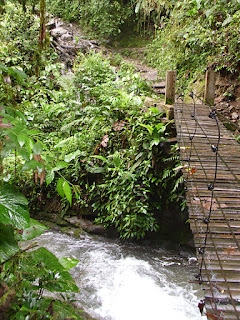
One of a number wood slat and cable bridges on the trail. 

It was water that brought humankind to land and, with its kinetic force, water made a rough landscape habitable for humankind.

We leave Mindo grateful for - and in awe of - water.


Saturday, May 05, 2012

Lima Love Park Adventure


Yours Truly beside the Sun Window at the Love Park. The inscription reads, "Tu de este lado y yo del otro como dos remos," or "You are on one side and I am on the other like two oars." At this moment, my boyfriend Matt and I are on either end of the Atlantic Ocean! :<


 Lima’s residents have a penchant for public flora…and for public displays of affection.

Gardeners have encircled fountains and granite statues with native ornamentals since the founding of the city.

Lovers on benches, beside the water, against the cold stone, wiggling their toes in the grass: were more numerous than pigeons in Lima’s parks even then.


The Moon Window at the love park. The benches in the park were inspired by Gaudi's manic mosaics at Parque Guell in Barcelona.


Kissing bodies  younger than they should have been or more married than they should have been hid in the manicured roundabouts, screened from view by a moat of muscular horses and grinding carriage wheels.

Today, PDA is no less ubiquitous in Lima. And urban planners have extended the greenbelt with two well landscaped pedestrian promenades.


It is the custom when one makes a commitment to a loved one in the park to make a heart with pebbles in the sand with the couples initials scratched in the center.


Avenida Arequipa’s handholding strollers can walk all the way from Lima Centro to the beach between lanes of frantic traffic with impatiens at every footfall. Tourists more conspicuously walk a similar East/West route through the desirable neighborhood of Miraflores (literally “Look, flowers!”) to Parque Kennedy where cafés and art are in abundance.

Poet Antonio Cilloniz is credited for inspiring the construction of El Parque del Amor, (“The Love Park”) in the early 1990s when he made a public observation that cities only dedicated monuments to their warriors and not their lovers.


"El Beso" by Victor Delfin. Delfin and his wife were the models. They are depicted barefooot!


Planners involved in a coastline redevelopment project, which would be capped with the addition of the dramatic cliffside mall Larcomar six years later, seized the moment and commissioned a sculpture from Victor Delfin. Within months, “El Beso,” the enormous pink monument at the heart of The Love Park was erected with Cilloniz’s quote inset at the base.

There is a small set of risers set into the park across from "El Beso," where, every year on Valentine's Day, Lima residents have a contest to see which couple can kiss the longest!

I visit The Love Park and see a mother taking photos of her son and his new fiancée while wiping tears from her eyes. A gay couple and a straight couple sit holding hands on opposite sides of a long mosaic bench, each blissfully unaware of the other. Hang gliders take off from a neighboring cliff and float overhead like love letters in the sky.


Wednesday, May 02, 2012

La Ronda Condo Adventure


(L to R: On the balcony of the La Ronda condo with El Panecillo in the background. A five minute walk up Morales brings you to this plaza and an even more amazing view of the monument.)

I had a wonderful time staying at Liliya and Leo’s La Ronda outpost.

It is magnificently situated with a vertiginous balcony overlooking cobblestone streets with the statue of El Panecillo in the near distance.

Readers should know that this handsome, two bedroom Quito unit is available for rental. At the time of this writing, the condo is miraculously available for the peak season (from May 18, 2012 throughout the summer.)  

Frequency Hopper readers who book Liliya and Leo’s La Ronda condo can receive a $25/mo discount!


Bear and I greatly enjoyed our comfortable Queen size bed.

This may not seem like a lot of cash, but as your dollar goes further in Quito, $25 will get you to any of the nation’s borders on a bus AND pay for your snacks!

You can contact the owners and see more pics here.

There are all sorts of other money-saving reasons to use Quito as a base.

Flights to Guayaquil, where all Galapagos Islands cruises board, are about $200 round trip if you pay cash for a local airline instead of booking credit card style with a provider in your home country. (The savings over a flight booked directly to GYE from SFO was around $100 to $150 per person.) 

The only way you can do this is if you are on the ground in Loja or Quito.

Also, from Quito one can more readily book or build day trips to the makets of Otavalo, the natural beauty of Peguche/Lago San Pablo, the not-in-Lonely-Planet adventures of Mindo’s cloud forest, and the hot springs resort of Papallacta.  Again, you MUST be paying with cash. 


A table in the living room area where I set up my writing desk. 

I favored Liliya and Leo's condo over a number of comparable units primarily due to it's location. I had the opportunity to stay in New Town, but the vibe isn't at all the same.

Once one is on the ground in Old Town, bakeries, fruit stands, and family run restaurants are all about. One of the best adventures is finding your favorites. 

There are numerous activities within a quick walk. It is difficult to think of a European capital with so many cathedrals of architectural and historic interest in such close proximity to one another.

The Changing of the Guard at the Plaza Grande is a must-see every Monday at 11 am.  I was fortunate enough to book the first part of  Holy Week and got treated to a street carnival on Palm Sunday.


(L to R: The archway to La Ronda just West of the condo. Yours Truly with my traveling companion Iona outside the condo after Palm Sunday festivities.)

Weekend nights, one hardly needs to venture into La Mariscal (aka “Gringolandia” in local parlance) for entertainment. Andean music, street vendors, and artists populate Morales Street.

When one does elect to explore, the inexpensive transit lines are all nearby. Taxi drivers always know Plaza Cummanda for fetching and dropping off.

I had a guest for two of my four weeks here. We enjoyed cooking meals in the clean, serviceable kitchen and posting details of our adventures online using the secure wireless internet. It was lovely to have a washing machine on site, also, for when we came back wet or muddy.


(L to R: The condo's lovely bath. Liliya's "welcome kit" for renters features dish and laundy soap, spare lightbulbs, paper products, and tea things.)

Liliya has a philosophical attitude about the distractions and annoyances of Quito. I found her wisdom and experience to be a generous bonus.

She and Leo clean the place top to bottom between tenants. In fact, the day I left, they put every piece of fabric in plastic bags and washed it.

I can’t wait to return to Quito for another writing retreat and expect to use it as a weigh-station for future travel in South America.

Monday, March 26, 2012

Mindo, Ecuador Bird Watching Adventure


A kingfisher in Mindo, Ecuador

The ground is colder than the air. There are long pauses between cricket hisses and frog groans. The cloud forest is waking up.

The van is late leaving and our group will have to hike fast if we are going to catch a glimpse of the elusive Andean cock-of-the-rock.

We find the way to the lookout shelter in the dark using phone lights and the red-eye polarizers on our cameras.

The pre-dawn path to the birding shelter has us knee deep in mud!


Julia Patino, our guide, teases us, “Didn’t anyone tell you to bring your torches?”

For a half-hour we trudge through mud and then we wait.

The Andean cock-of-the-rock is shy, rarely perched “in the open.” If we are lucky we will see a hint of bright red plumage.

Patino initiates some bird calls, then names the birds that respond. This technique is called pishing.  Her calls are remarkably effective.


She sets up a sight for us, predicting where the birds will land and how they will move or react next.

Over the course of three hours, we see parrots, toucans, and a broad variety of taningers. We see velvet coronets, and rufous motmots, and a golden headed quetzal.

And we see our Andean cock-of-the-rock. Three of them, in fact!


Birding is big business in Ecuador. In the tourist town of Mindo alone there are three full time birding operations featuring multiple guides with gaggles of letters behind their names.

Julia is independent and has been working in the region for over a decade. She knows all the sweet spots:  not just in the sanctuaries, but on random hillsides and highways.

Our group sitting down after birding to relax and share impressions.

When we break for an early lunch, I’ve improved my life list by nearly 30 species. 

Now that’s what I call a Big Day!

Sunday, March 18, 2012

Peguche Falls Adventure


Your's Truly at Lago San Pablo. Pijal is the mountain in the background.

Otavalo has become known over the decades for its surreal open markets.

Chinese knock-off products share stalls with traditional Ecuadorian crafts. A waxy, roasted pig’s head advertises every lunch counter and dogs kick leftover bones through the stands of local superfruits.


The market scene in Otavalo on a typical Saturday.

My hiking pal Iona and I launch our day trip from Quito’s northernmost neighborhood, called “La y” (“the and,”) indicating it’s history additive to Old Town Quito.

Transferring from the city’s Trolle line, we board a provincial coach. The total round trip cost is only $7, but one pays a little bit of that $7 every time one transfers to a new coach (six times), so it is wise that we are carrying change in coins.

Though the travel time is advertised as two hours, the trip north takes almost three as the coach stops for a seemingly endless array of non-paying Otavaleño passengers and food vendors.

Once in Otavalo, it is clear the principal experience is actually having made the pilgrimage on a Saturday. 


My hiking companion, Iona, in front of Otavalo's Town Hall.


Many Otavaleños “made good” in Quito return, wearing their native costumes and to be a part of the community ritual. 

Unlike other parts of Ecuador, where a man like me with long hair stands out, I appear to be emulating the Otavaleños on the day of my visit.

It is traditional for Otavaleño men to grow their hair long, and wear it in a pony-tail or braid it. Of all parts of the regional costume, the men's manner of wearing their hair may be the solitary pre-Columbian element. 

The preservation of this tradition is so revered that Otavaleño men may keep their braids if they elect to join the military in Ecuador. 

Since all the goods available in Otavalo can be purchased conveniently at similar prices elsewhere, we spend little time at the busy market. 

We decide to journey 4K southeast of town to the natural attractions around Lago San Pablo. 

Iona alongside Lago San Pablo. Volcan Imbabura in the distance.

Lago San Pablo is unusual for a number of reasons.

First, there is a algae-like mold in the marshes surrounding the lake that is unique to the area. It was created when lava flow from Volcan Imbabura blocked the lake’s natural drainways.

Second, the lake is home to the Andean climbing catfish.

The fish use their tail and mouth to climb rocks. The fish likely migrated by land down from the higher elevations to Lago San Pablo using these unique skills!

Third, the cane from the lake provides raw materials for the local artisian speciality: mat weaving.

When we visit, two older women are actively harvesting the cane to take home and braid.

We make our way around the lake and spot several different paths relevant for hiking off into adventure. 

The locals people are very friendly and quick with a kind word or helpful information. They are also enjoying their Saturday.  Three brothers spend a considerable amount of time on logistics before we watch them attempt to ride the a bicycle all at the same time.

Ultimately, the back road to Peguche is the one we stumble up. 


Two views of the Peguche falls.


One woman is standing on the banks using the water from the falls to help plait her daughter's hair. 

On the path running along the falls,  I spot a kind of mountain rhubarb with numerous red hairs and chuquiragua flowers.

Local flora includes relatives of raspberry and allium as well as eucalyptus and chiquiragua.

Many people expect this region to have a tropical, jungle climate, but Otavalo and environs are semi-arid. Pampas grass, agave, and eucalyptus grow here.

Our options for crossing to the business end of the falls are a large felled tree or a rickety suspension bridge with missing slats. We wisely take the bridge.

The sign for this bridge discouraged visitors from jumping while walking across, apparently the cause of some missing wood slats.

The Peguche artisan village is meant to showcase local weaving, but it is essentially another point-of-sale for inexpensively made semi-authentic souvenirs.

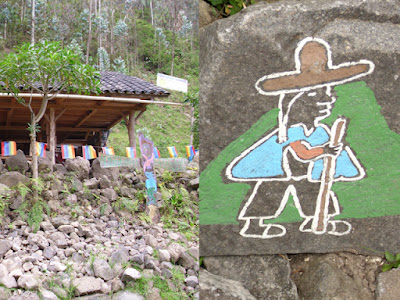
Painted rocks and placards at this structure explain the native ritual of Yamor, an annual cleansing in the falls.

While it is likely that many of the flutes and seed jewelry was created locally, I examine a charango which seemed typical of the available items. The instrument is strung with monofilament to perform as a child’s toy and spraypainted with a stencil of Spongebob Squarepants.

Iona makes a purchase: roasted plantain and corn-on-the-cob from an open fire.

Yours Truly and a reconstructed, pre-Columbian stone circle. 


An oddity I enjoy in the village area is an unmarked, unexplained pre-Columbian ruin.

From information gathered online, I understand that the most of the cobblestones on the ground are original, but that the walls and alcoves have been almost entirely reconstructed.

Hopefully, the same interests that reconstructed the stone circle will see to it that some kind of signage or marking can be established to give tourists a greater appreciation of its significance.


Tuesday, March 13, 2012

Old Town Quito Adventure


Mounted swordsman preparing for the weekly Changing of the Guard.

The first thing I notice hiking around hilly Old Town Quito is that everyone has a dog.

Most are big dogs. Most will not be attending obedience school.

The dogs in Old Town bark all day and all night at car alarms, ambulances, and, of course, the barking of other dogs.


The neighborhood of La Ronda was home to poets and other artists during the Modern period.

These dogs are generally working as guardians. They are well fed and attended. The social function of companion animals is just different for Quiteños than what U.S. citizens are used to.

The second thing I notice is lots of police.

There are two or three uniformed officers at every plaza or major intersection.


Another surprising fixture downtown: men wandering about selling coca leaf tea.

You cannot find matte de coca tea at the two chain grocery stores in Old Town, but it is entirely legal to purchase and enjoy throughout South America.

It is touted as a cure for altitude sickness. Quito is 2850 meters above sea level. 

To put that into perspective,  Denver, in my home state of Colorado, is 1609 meters above sea level! 


A statue of the Virgin Mary watches over Old Town from El Panecillo.

Things commonly found in abundance in Spanish Colonial capitols are exceptionally well preserved and functional in Quito's Old Town. 

The architectural influence is deep: Stone churches, elaborately carved wooden doors, red tile roofs.


One of Old Town's many churches (San Augustin) which mix local and Spanish elements.

Nearly every available archway or shelter is occupied by a "tienda" or little store. Baked goods, produce, yarns, and durable items are all sold in different tiendas.

There are scads of endearing lunch places, typically run by families. They are affordable, and filled with locals.

I don’t know how the Quiteños decide!


Yours Truly in Plaza Grande for the Changing of the Guard

The big event weekly in Old Town is The Changing of the Guard on Monday mornings at 11 am.

Unlike similar ceremonies in other world capitols, the President of Ecuador is regularly present for the event, waving from the long balcony at the top of the Presidential Palace.

In addition to swordsmen on horseback and pikemen, a marching band plays the national anthem and a choir of schoolboys sings along.


It is a tribute to the people of Ecuador that other nations regard it as stable even though it has had a major domestic war in the last 25 years and an awkward coup attempt as recently as 2010. 

With all the upheaval in Ecuador's history, the regulating contribution of an event like this to the national psyche is estimable!