Showing posts with label hiking. Show all posts

Tuesday, May 22, 2012

Mindo Ecuador Waterfall Tour Adventure

Water rushes over our hiking path in Mindo, Ecuador. I try to cross without using my hands!

All the QuiteƱos know Mindo. They venture to this cloud forest town for adventures in nature. 

The editors of Lonely Planet don’t mention Mindo in their guidebooks, yet.


Iona and I stay at La Casa de Cecilia. This is our ground floor room.


Once they do - once the town has a few ATMs, once there are a few places where it is possible to pay with a credit card - foreign tourists will storm it.

In order to visit, one must budget and bring cash.

Rather than made a reservation with one of the two or three sterile resorts that take them, it is best to set aside money for each day and stick to your limit. Follow your fellow tourists and join with them to collect discounts on common lodgings and activities. 


View of downtown Mindo from the back of our waterfall tour "taxi."

Iona and I take a three hour bus ride from Quito’s Ofelia bus station to Mindo.

As our driver ascends the switchbacks and the air begins to get  thinner, mists roll in over the craggy, bromeliad and vine covered mountains.

 Nature along the trail (clockwise from upper left): Morphos butterfly. A photogenic relative of the violet. A bromeliad sprouts up from a few slivers of rotten wood. 

We arrive and find an English speaking tour operator across the street from the bus station. Other tourists arrange for a waterfall tour with us. Negotiating a group rate saves us $4 each.

With Nambillo Falls as our final destination, we hike past seven smaller, equally spectacular waterfalls.

One of our Australian friends takes a solo dip in this lovely cascade.

Our entire party gets wet here. Iona and her friend are the last ones out from under the falls.

While everyone enjoys splashing in a waterfall, far tumbling water feels deeper in significance for me.

These dramatic drops evidence the relative youth of the planet. Where water has time to do its work, mountains are brought down to the size of hills. Meandering brooks through a meadow are sometimes the only evidence that water was responsible.


Don't forget to use water tablets if you fill your canteen from these springs!

Iona backs me up as I hug a mossy tree.

Waterfalls demonstrate for how water connects all life. Once most of the planet was like the cloud forest: humid, dense with vines, difficult to navigate. Then the clouds came to earth in the form of water. 
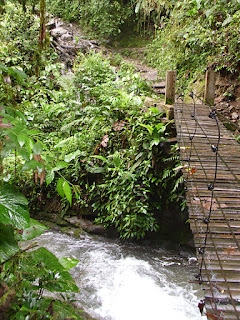
One of a number wood slat and cable bridges on the trail. 

It was water that brought humankind to land and, with its kinetic force, water made a rough landscape habitable for humankind.

We leave Mindo grateful for - and in awe of - water.


Tuesday, May 08, 2012

Tennessee Valley California Hiking Adventure


Tennessee Valley Cove in the Golden Gate National Recreation Area. 

When I’m looking for a quick escape from San Francisco, Yosemite, the Russian River, and the Napa Valley are close at hand.

But each of these options requires significant forethought. I wonder if will they be crowded with international tourists on a given weekend? Is there an incoming convention or a gigantic cruise ship in port? That could lock up available lodging and recreation.

Then, since like most San Franciscans I don’t own a car, I have to plan out the transit.
Which bus connects to which bus where?

Finally, do I have the money to truly enjoy these places?


The Tennessee Valley Trail as seen from Wolf Ridge.

My ideal solution to the getaway problem is the 76 bus. From Van Ness and Geary the 76 bus line will take me to the Marin Headlands and The Golden Gate National Recreation Area for the price of my daily commute to work.


A dramatic scene from the climb to Tennessee Point.

The United States Navy once based defensive operations for the Pacific in the Headlands. The buildings are still standing, converted into artist spaces, non-profit offices, history museums, and hostels.

The real treat for me is how much land is left untouched by development. I can hike a dozen miles of trail before seeing so much as a vehicle or a home.

Matt and I make our way to the Headlands on a sunny, blustery day with the goal of hiking the Tennessee Valley.


Matt buffeted by winds at Rodeo Beach. 

We start off at Rodeo Beach where a number of men with metal detectors are scanning the strand for treasure. Notable relics are said to wash up here.

A pair of parents with young children hikes up ahead of us to Tennessee Point. It’s an easy, physical hike… but we’re going all the way up the mountain.

Atop Fort Cronkhite, we explore the old ramparts and vacant magazines. We make our way to Wolf Ridge and the Tennessee Valley Trail. We find columbines, blue flax, monkey flower, California poppies, and white yarrow blanketing the scrubby hills.


California native plants L to R: blue flax and yellow monkey flower.

At Tennessee Valley cove, we enjoy the drama of the Pacific Ocean tides. Iron clotted cliffs bolt rust red into the sky. I’m so distracted by the landscape my boots get caught in the undertow and flood with seawater. Matt, too, is blissed out with endorphins and beauty. 


Thursday, November 04, 2010

Aegean Adventures - The Delphic Oracle Pics

The ruin of the Temple of Apollo where signs were once read. In ancient times, the Oracle was one of a number of female religious leaders. Now the grounds of her temple are what is referred to as The Oracle.

Statues at the Delphi Oracle Archeological Museum

An enormous marble replica of the Sphinx at the Delphi Oracle Archeological Museum

The twin cities of Kirra and Itea in the distance on the Ionian Sea.

The last intact obelisk at Delphi

The temple of Athena a short walk south of the Oracle

Text from one of the fallen obelisks. It's tough to translate as there are no spaces or punctuation and all the spellings/words are outdated.

Yours Truly at the Temple of Apollo

The Treasury of Athens, the last freestanding building at Delphi

Aegean Adventures - The Delphic Oracle

Mists envelop the Oracle at Delphi


The Oracle is the country’s number two tourist attraction after the Acropolis. In part, this is due to a confluence of destinations nearby.


The extra-long European Rambler hiking trail runs through the area. The Oedipal crossroads are still visible in a nearby tourist town. In winter, there is skiing in this part of Greece.


It is three hours each way from Athens through some beautiful countryside.


The day I went, the Oracle was desnse with mists. The cypress trees were wet. Wrinkled olive fruits, ripe enough to eat, fell and split into oily puckers under the feet of the tourists.


I had befirended an Italian student and a Dutch military man on the bus ride to Delphi. We attempted to find the site unguided in the drizzle. Since the site is not well marked, we wound up about a kilometer above it, unable to hike down except to go the way we came.


When we did reach the Oracle, it was uncrowded. There were a few tours being offered - in Japanese and English. We discovered a wide discrepancy between the adult tourist price and the student price. I paid 9 euros for entrance while students paid nothing. Not 50% off or 70% off, students paid zero!


The archeological museum at Delphi has a collection of artifacts recovered over the last 150 years, including hawk-shaped cauldron handles, larger than life kuros, an Amazon battle frieze, and bronze offerings.


A print by an artist attempting to recreate the look of the Oracle circa 4 BC prompted me to consider how magnificent the site must have been at the peak of it’s influence.


Outside the museum, the ever upward trajectory of The Oracle gave me a feeling for how hearty the early Greek citizens must have been. While it is unlikely the majority of Greeks lived even as long as I have, they would all have needed exceptional mobility to ascend to the upper grounds.


The levels of the Oracle included mausoleum-like treasuries, the temple of Apollo where fortunes were told, public art, a theater, and a stadium. I took lots of pictures and even tried to translate some of the ancient Greek carved into the obelisks.


It is odd that even today Greece does not hold re-enactments or has not re-created any of it’s ancient temples even in part even though copies exist in other parts of the world including Nashville, Tennessee.


Just down the road, one can visit the temple of Athena, flanked by olive trees, and the ancient gymnasium. Admission is free to both these attractions.


Wednesday, October 20, 2010

Milos Greece Adventure Pics

The mountainside town of Trypiti on Milos


In front of the black lava rock tower of the ancient theater of Milos near where the Venus De Milos was discovered.


A look down at the ancient theater from a nearby cliffside, just beyond this is the Mirtoon Sea

The port city of Adamas on Milos where I stayed for two nights

Milos Greece Adventure

Ships bobbing in the port city of Adamas on the island of Milos


I left Serifos two days ago on a rainy afternoon, attempting to make the best of my remaining days in Greece with some island-by-island adventure.


I jumped on board the ferry for Milos, original home of the Venus de Milo, just in time to depart. The ride was smooth, about an hour and a half long, with a brief stop on the island of Sifnos.


The home I stayed in on Serifos had a great deal of fine pottery from Sifnos including a few beautiful blue bowls.


Upon landing in Adamas, a woman from town wandering the port asked me if I wanted a room. Her name was Nina. When I told her I was from San Francisco, she informed me she had relatives there.


I was led to a handsome small apartment building with rooms nested on three floors. Past flanks of black and white cats, I climbed the stairs.


The room was comfortable and clean with a refrigerator full of peas and bread and a hot pot. A gorgeous hand blown poppy-flower shaped fixture hung above the bed, with drizzles of gold paint in cross-hatch patterns. A matching bamboo loveseat and couch with a geometric patern in browns and greens from the 1960s. Other cozying elements included crocheted cozys and doilies.


It was maybe only the fifth night this year I’ve slept with a pillow that wasn’t meant for a plane. And probably one of the few in the last week where I slept for more than an hour or two.


The water was not potable, however, it was plentiful. It was tepid enough I could take a shower without shivering.


The port in Adamas was brightly lit against the blue water. I walked past bobbing boats to catch the Tripyti Road.


The vegetation here is a little different than in Serifos. Some beautiful red berries plants I could not quickly identify, gave off a sweet apple and rose smell. Sage and eucalyptus I broke off in pieces and inhaled.


Tripyti is a small town, like many others in Greece, with narrow streets and cafes and outdoor shops.


Guidance may vary during the tourist season. I found a single open market just past the main road. It took me close to an hour!


I was pleased to find Orangeade and Smarties, a British candy I enjoyed when I first came to Europe in my teens.


Just past is the Tripyti Theater, a lava rock and marble beauty, facing the Mirtoon Sea.


I imagined what it would be like addressing a group of people on the floor of the ampitheater.


I sat on some of the old marble columns and touched rocks and trees all along the road to leave a bit of my energy with Milos.

Serifos Hiking Adventures - The Road to Taxiarchon Pics


The Taxiarchon Monastery compound as seen from the Southeast corner.


Pink double doors leading to the artifact laden inner sanctum of the order.
The small town of Kendarhos on the way back to Hora from Taxiarchon.

The exquisite Kendarhos beach

Cats hanging out on the balconies of the monastery

Tuesday, October 12, 2010

The Road to Koutalas Bay Hiking Adventure Pics

Beside the White Tower at Aspros Pyrgos
A roadside prayer station. Inside were pictures of a Greek Orthodox leader and offerings.

The still-active graveyard at Aspros Pyrgos.

Some fowl curious about what manner of beast I was.

The big payoff: Koutalas Bay. And no competition for the beach!

Serifos Hiking Adventure - The Road to Koutalas Bay

The ancient white tower ruin and the church at Aspros Pyrgos


West from the Petrias Trail and Pyrgos Trail crossroads, hikers may take the road to Koutalas Bay.


My journey was relaxing and filled with small entertainments.


One feature strongly noticable along the road was the presence of the Greek Orthodox Church.


When the Romans wanted to introduce the Christian faith, they selected Greek as the language to do it in. It has been my experience that friends and acquaintences with a Greek ethnicity or childhood ties to the church are very protective of the religion’s pride and traditions.


I enjoyed the “sugar cube” churches and prayer points along the way. One was on the south side of a livestock farm where a shepard was shouting to her flock in heavily accented English, “out, out!”


Another point along the roadside featured a handsome roadside box, containing an image of a Greek Orthodox leader along with incense and offerings which I assumed to be tributes for a deceased relative.


I crawled around a stone fortification just off the road constructed of gliting green shale. I spied an alternative route I might have traveled off the road through a property “for seize” the direct translation of the Greek word indicating a property is available.


If you are planning to trek off route in Greece, you should know how to recognize the Greek words indicating hazards or passing rights that can be found in many reputable travel manuals. I found “falling rock” and “no passing” signs to be fairly obvious in spite of the fact I do not speak the language with great depth.


The last portion of the trail included a brush by a sustainence farm replete with several birds curious at my presence and a barking dog.


I arrived at Aspros Pyrgos where I explored the relic of an white marble tower and an Greek Orthodox graveyard still in use. Some of the stones there indicated parishoners of the nearby chruch who had passed within the last ten years.


Koutalas Bay is a scenic inlet on the cusp of the Mirtoon and Aegean Seas with a cloverleaf shape.


The beaches the day I went were utterly uncrowded, though the only business in evidence was a boat rental shop, so it would be wise to bring sufficient food and water.

Road to Pyrgos Hiking Adventure Pics


Wild grapes above and below raisins drying on the vine. Delicious!

A look down the valley to the Mirtoon Sea.


Outside a copper shale ruin on the road to Pyrgos.


Some of the critters on the road: preying mantis, sheep, mule, butterfly.

The twin villages of Pyrgos and Gallani.


Wild fruit: white fig and cedar berries.

Serifos Hiking Adventure - The Road to Pyrgos

A pastoral view of Kythnos as seen from the road to Pyrgos on Serifos, Greece.


The Northern part of Serifos is a place of small-time agriculture. Sustenance farms, wild unpicked fruit, shepards and mule-packers.


At the beginning of my hike, I munched on some Greek dandelion roots and buds and wild raspberries. Suplimented with some oil crackers and water from my pack, they made a energy packed breakfast.


Greek dandelions have a delicate flower and soft crunchy root. The best specimines are picked between loose rock where there is not a lot of sediment. A bud or two about to open are best. As always, it is important to rinse anything you find on the trail and wash it down with plenty of water.


Located at the end of the Petrias trail, the Road to Pyrgos leads up a steep incline of thistles and spiny local folliage.


Of all my time on all the trails here, I have only communicated with two local hikers and I exchanged greetings with them on this walk.


Creon was sitting at the base of the first peak with his cane in brown pants and a brown shirt, missing his front teeth. He was very affable even though my Greek failed me. He managed to offer his name and that he was from Hora. I offered mine and said I was from California. I was wearing a very flashy t-shirt on which a stoned walrus was driving a 22 Fillmore bus out of which money was flying. I must have been quite a sight for him!


Once over the crest, I continued on the road as led to a handsome view of the island of Kythnos and the Mirtoon Sea.


It was here I found an outcropping of cedar berries. The flesh is loose with a sticky persimmon-like gel inside, the seed is astringent like pine sap. While the seed may be eaten, I discarded it since I was not familiar with this particular variety.


I also found a ripe white fig and got a surprise when I opened it and a small, albino bug was feasting on the inside. I left it on the trail to distract the many flies that were following me.


Closer to Pyrgos, I saw a good deal of livestock. A mule was very patiently and precariously vertical on a steep incline. There was a sheep herd drinking from a trough with a mother and her ewe admiring one another. In the valley, another woman was calling her sheep to follow her.


When I finally reached Pyrgos, I could see it’s sister city Gallani in the distance. Both are perched cliffside. I crawled up the steep stairs along with a mule packer and his dog for a better look. There is no visible tourist infrastructe here, but there is daily bus service in the am and pm.


On the road back, I saw some really cool bugs. I had my first taste of vine-dried raisins and then grapes, growing along the road back to Hora.


After picking them, I slipped and fell at the sound of a man singing, smooshing most of them and sustaining and injury to my elbow. (I'm healthy, just a little bruised up.) Had I not been convinced to leave my scissors at home, I might have had grapes and rasins even now!


Wednesday, October 06, 2010

Road to Petrias Hiking Adventure Pics

Hora as seen from the peak of Mount Livandera.

Lizards are in abundance on the Road to Petrias.

A sample of some of the flowers blooming on the trail.

The trail begins in earnest with a long granite path set into the side of Mount Petrias.

The windmills west of Hora are the jumping-off point for this adventure.